Showing posts with label Islamic Articles. Show all posts

BENEFITS OF AYATUL-KURSI


THE BENEFITS OF AYATUL-KURSI
It is the Most Respectable Ayat of the Qur'aan Kareem.

1).Hadhrat Ali bin Kaab (Radiahallahu Anhu) remarks that Nabi (Sallallahu alayhi wasallam) asked him," Which is the most high ranking Aayat in the Qur'aan Kareem?" He said, " Allaah and His Rasul know best". Rasulallah repeated this statement very often. Hadhrat Ali (Radiahallahu Anhu) stated, "Ayatul Kursi". Nabi (Sallallahu alayhi wasallam) said:"Oh Abul Munzar (family name of Abi bin Kaab). May you be blessed by this knowledge. I swear by that Being in whose Hands and Control is my life, that this Ayat has one tongue and two lips. It is by the threshold of Allaah's Arsh, Mentioning His purity".
2) Hadhrat Ali (Radiahallahu Anhu) states that there was a room of dates, which he used to guard. He suspected that some dates were going missing. Thus one night he stood vigil and saw an animal like a young person. Hadhrat Ali (Radiahallahu Anhu) said: "I greeted and received a reply". I asked," Who are you? Man or Jinn?" It said, "Jinn. I said, Give me your hand". He outstretched his hand. I noticed that the hand was like that of a dog. Its hair like the hair of the dog. I asked, "Are Jinns created like this?" It said, " the Jinns know there are amongst them more stronger ones". I enquired," Why did you steal?". He replied," I have come to know that you love to give charity so I decided to take a part also." Hadhrat Ali (Radiahallahu Anhu) said: " Who will save us from your evil? It said, Aayatul Kursi which is in Surah Baqarah. He who reads it at night will be saved from our evil till the morning and he who reads it in the morning will be saved from our evil till the night."

In the morning Hadhrat Ali (Radiahallahu Anhu) came to Nabi (Sallallahu alayhi wasallam) and narrated the entire event to him. Nabi (Sallallahu alayhi wasallam) said,"That rascal has stated the truth although he is a great liar."

3) It is reported from Hadhrat Askee Baqri that Nabi (Sallallahu alayhi wasallam) came to the abode of the Muhajreen when one person asked, "In the Qur'aan Kareem which is the most lofty Ayat?" Nabi (Sallallahu alayhi wasallam) repeated "Ayatul Kursi".

4) Hadhrat Hassan reports "Marfoonaan"," I have been given Ayatul Kursi. Nabi (Sallallahu alayhi wasallam) said," Surah Fateha, Ayatul Kursi and the two Ayats of Al-Imraan (Shaheedal Allaah - 18th Ayat), and "Qul Allaahumma Malekal mulk til Bi Ghairi Hisaab (Ayat 26/7) are attached to the Arsh and say, "Oh our Rabb, You are sending us onto earth to disobedient ones!!! Allaah says ," I have given you such status, whosoever from amongst my servants recites you after every Salaat, his resting place will be Jannat. And I will make his abode in Jannatul Quddoos and fulfill 70 needs of his daily needs, the least of which is forgiving him and saving him from all enemies of evils.

It is a quarter of the Qur'aan Kareem.

5) Hadhrat Anas (Radiahallahu Anhu)narrates that Rasulallaah (Sallallahu alayhi wasallam) asked one of his companions: " Oh, so and so are you married?" He replied: "No, I do not have enough wealth that I may marry.", Nabi (Sallallahu alayhi wasallam) said: "Do you know Surah Qul Huwallaahu Ahad?" The Sahaba replied: "I know". Nabi (Sallallahu alayhi wasallam) said: "It is equal to a quarter of the Qur'aan. Nabi (Sallallahu alayhi wasallam) asked: "Do you not know Qul Yaa Ayyuhal Kaafiroon?" The Sababi replied "I know". Nabi (Sallallahu alayhi wasallam) said " "It is equal to a quarter of the Qur'aan." Nabi (Sallallahu alayhi wasallam) asked, "Do you not know Surah "Iza Zul Zilzilaat " ?" The Sahaabi replied, "I Know". Nabi (Sallallahu alayhi wasallam) said: "It is a quarter of the Qur'aan". Nabi (Sallallahu alayhi wasallam) asked: "Do you not know Surah Iza Jaa a Nasrullaahi Wal Fath" The Sahabi replied "I Know" Nabi (Sallallahu alayhi wasallam) said, it is a quarter of the Qur'aan. Nabi (Sallallahu alayhi wasallam) asked: "Do you know the Ayatul Kursi?" The Sahabi replied "I know". Nabi (Sallallahu alayhi wasallam) said, "It is equal to a quarter of the Qur'aan. Marry, Marry, Marry."


Consistency and Ayatul Kursi

6) Hadhrat Anas (Radiahallahu Anhu) said that Nabi (Sallallahu alayhi wasallam) said, "The one who recites Ayatul Kursi after every fard Salaat will be protected until the next Salaat and this is constantly done by a Nabi or a Siddiq or a martyr.


7) Hadhrat Hassan bin Ali (Radiahallahu Anhu) says, "A person once asked: "Oh Rasulallaah (Sallallahu alayhi wasallam) what does that person receive who recites Ayatul Kursi after every Fard Salaat ? Nabi (Sallallahu alayhi wasallam) said: " That person remains under the protection of Allaah until the next Salaat."


8) Hadhrat Anas (Radiahallahu Anhu) says: Rasulallaah (Sallallahu alayhi wasallam) asked; "Do you know which Ayat in the Qur'aan is most lofty? " I said, Allaah and his Rasul know more." Nabi (Sallallahu alayhi wasallam) read Ayatul Kursi

9) Hadhrat Efai bin Abdullah Kallee said that one person asked."Oh Rasulallaah (Sallallahu alayhi wasallam), which Ayat in the Qur'aan is the most lofty one?" Nabi (Sallallahu alayhi wasallam) said: " Ayatul Kursi". The person asked,"Which Ayat has those benefits which you desire for your Ummah, in the Qur'aan?" Nabi (Sallallahu alayhi wasallam) said: "The last Ayat of Surah Baqarah, for it is from the treasures of Allaah from underneath the threshold of the Arsh. It encompasses all the good of this world and the Aakhiraat".

10) Hadhrat Muhammad bin al Saumi bin Al Salsal bin Damasc narrates from his father, who in turn, narrates from his father that Rasulallaah (Sallallahu alayhi wasallam) said: " Whoever recites Ayatul Kursi after every fard Salaat, there is only death between him and Jannat", he will enter into Jannat immediately when he dies.

11) Hadhrat Ibne Anas (Radiahallahu Anhu) says that Rasulallaah (Sallallahu alayhi wasallam) said: "The one who recites Ayatul Kursi after every Fard Salaat, Allaah Ta'aala will grant him a gratifying heart, actions of the truthful and reward like the Ambiyaa .Special mercies will descend upon him, and death is the only barrier from his entrance into Jannat. On dying he will enter Janaat".

Blessing in the food

12) Hadhrat Ayesha (R.A.) narrates that one person came to Nabi (Sallallahu alayhi wasallam) and said that there was absolutely no "Barakat" (blessings) in the things at home. Nabi (Sallallahu alayhi wasallam) replied, "Why are you neglectful of Ayatul Kursi."

Whenever Aayatul Kursi is recited upon food, Allaah Ta'aala will increase the Barakat in that food or curry.

13) Hadhrat Ibn Masood (Radiahallahu Anhu) says that Allaah the Lofty did not create any thing in the skies or on earth, in Jannat or Jahannam, loftier than Ayatul Kursi.

14) Hadhrat Ibn Masood (Radiahallahu Anhu) says that no space in the sky, or on the earth is loftier than Ayatul Kursi.

To make Satan flee for protection of wealth, property and home

15) Hadhrat Masood (R.A.) states that a person left his home and met a Jinn on the way. The jinn asked him, "Can you drop me down?, If you do so then I will teach you such an Ayat that if you recite it upon entering your home, Satan will not enter." They wrestled and the person dropped the Jinn down. The jinn said:"Read Ayatul Kursi, because that person who recites it upon entering the home, Shaitaan flees like a donkey making a sound from its posterior runs away.

A person mentioned to Hadhrat Ibn Masood that the person (who dropped the Jinn) could only be Hadhrat Umar (Radiahallahu Anhu).

Hadhrat Abu Hurairah (Radiahallahu Anhu) narrates this (above) Hadith from Rasulallaah (Sallallahu alayhi wasallam), with the addition that there is an Ayat in Surah Baqara, which is the chief ayat of the Qur'aan. Whosoever recites it in a house wherein Shaitaan is, he (Shaitaan) will leave.

16) Hadhrat Ibne Masood (Radiahallahu Anhu) says that a person requested Rasulallaah (Sallallahu alayhi wasallam) to teach him something that will benefit him. "Nabi (Sallallahu alayhi wasallam) said,"Read Ayatul Kursi, it will protect you, your children, home and even those houses surrounding your house."

17) Hadhrat Ibn Umar (Radiahallahu Anhu) narrates that once Hadhrat Umar (Radiahallahu Anhu) came to the people and said, "Who amongst you can tell me which is the most lofty Ayat in the Qur'aan, which Ayat directs one most towards justice and fairness, which Ayat creates the most fear and which Ayat creates hope for mercy?" All remained silent. "Hadhrat Ibn Masood (Radiahallahu Anhu) said,"I heard Rasulallaah (Sallallahu alayhi wasallam) say from the Mimbar (pulpit) that Aayatul Kursi is the Loftiest in the Qur'aan, and the Ayat which encourages justice and fairness is ( Arabic P12) and the Ayat that creates the most fear is ( Arabic P12) of the Ayat that creates the most hope of mercy is ( Arabic P12).

18) Hadhrat Ibn Abbas (Radiahallahu Anhu) said that when Rasulallaah (Sallallahu alayhi wasallam) recited the last Ayat of Surah Baqarah and Ayatul Kursi then he laughed and said," These have come from the treasures of Allaah." and when he read (May Ya'mal Soo), then he said (Inna li llaah...) and chose humility and meekness.

19) It is reported that when ever Hadhrat Abdur Rahman Bin Auf (R.A.) entered his home, he used to recite Ayatul Kursi in its corners.


20) Hadhrat Hassan (Radiahallahu Anhu) narrates from Rasulallaah (Sallallahu alayhi wasallam) who said , " Jibraeel came to me and informed me that a rebellious Jinn is plotting against you, so when you retire to your bed, then recite Ayatul Kursi. "

21) Hadhrat Ali (Radiahallahu Anhu) says that the chief of the Ayats of the Qur'aan Kareem is Ayatul Kursi.

22) Hadhrat Ali (Radiahallahu Anhu) says "I have heard Rasulallaah (Sallallahu alayhi wasallam) say that person who recites Ayatul Kursi after every Salaat, only death prevents him from Jannat and who recites it whilst retiring to his sleeping place, Allaah will protect his house, his neighbours and even his surroundings.

23) Hadhrat Ali (Radiahallahu Anhu) says that I cannot comprehend that a person who is a born Muslim, or intelligent or one who accepted Islaam in a rational (Arabic) state spending the night without reciting Ayatul Kursi. If you know how lofty this is (you will never discard it), it has been given to your Nabi (Sallallahu alayhi wasallam) from under the treasures of the arsh. It has not been given to any Nabi (Sallallahu alayhi wasallam) before your Nabi (Sallallahu alayhi wasallam) and I have never spent a night without reciting this Ayat thrice. I recite it in the last 2 Rakaats of Witr after Esha and also when I retire to my sleeping place

24) Hadhrat Auf bin Maalik (Radiahallahu Anhu) says that Hadhrat Abu Zar (Radiahallahu Anhu) who was sitting near Rasulallaah (Sallallahu alayhi wasallam) asked: "Oh Rasulallaah (Sallallahu alayhi wasallam) which is the most lofty Ayat Allaah revealed to you?" Allaah's Rasul recited Ayatul Kursi.

Hadhrat Ma'aaz bin Jabal (Radiahallahu Anhu) says that he stored the dates for charity of Nabi (Sallallahu alayhi wasallam) in a room for safe keeping. I sensed that there was a shortage daily therein. I complained to Rasulallaah (Sallallahu alayhi wasallam) about this. He said that this was the work of Satan and I must stay alert for him. Thus I sat in the barn that night. When some part of the night passed, Shaitaan came in the shape of an elephant. When he came near the door, he changed his shape and entered through one of the holes of the door, moved towards the dates and began eating. I dragged my cloth near him and said: "I testify that there is no one worthy of worship but Allaah and that Muhammad is his Servant and Rasul. Oh Allaah's enemy you are usurping the dates of charity whereas the poor are more deserving of this than you. I will definitely apprehend you and take you to Rasulallaah (Sallallahu alayhi wasallam) who will humiliate you." At this Shaitaan pledged that he will not do this act again.

In the morning I came to Rasulallaah (Sallallahu alayhi wasallam) who asked me about my prisoner. I stated that he had vowed not to steal again. Nabi (Sallallahu alayhi wasallam) said that he (Satan) will come again so be alert. The next night also I sat alert. The same thing occurred and once again he (Satan) pledged not to steal. I left him. In the morning, I narrated the whole event to Nabi (Sallallahu alayhi wasallam) who said that he (Satan) will come again. On the third night the same thing happened once again. I apprehended him and this time I said,"Oh Allaah's enemy, you have pledged twice and this is the third time (now I will not leave you). He (Satan) said," I have children and have come from Nasabeen ( a place between Masool and Syria). If I receive anything less in status than this (dates), then I would not have come here. We left this city of yours when your Nabi (Sallallahu alayhi wasallam) was sent together with two Ayats which removed us from here to Nasabeen. Shaitaan does not enter any home when these two Ayats have been recited in it". He said this thrice. "If you leave me, I will show you these two Ayats". I agreed. He said," Ayatul Kursi and the last Ayat of Surah Baqarah (Amanas Rasul....)."Thus I let him go. In the morning I came to Rasulallaah (Sallallahu alayhi wasallam) and told him what had transpired. Nabi (Sallallahu alayhi wasallam) said, "That rascal has spoken the truth even though he is a liar."

Hadhrat Ma'aaz (Radiahallahu Anhu) says after that he used to recite this and blow on the dates and there were no shortages in the room.

26) Hadhrat Abu Asaad Saeedee (Radiahallahu Anhu) narrates that he plucked the fruits from his orchard and kept them in a room. Jinnaat used used to come to this room and steal the fruit. This put them in difficulty and they complained to Nabi (Sallallahu alayhi wasallam) about it. He said,"This is (the work of) a Jinn. Oh Abu Asaad, listen attentively, when he (the Jinn) has entered, then say. "I take the name of Allaah" and say "accept Rasulallaah (Sallallahu alayhi wasallam) sayings". The Jinn said, "Oh Abu Asaad, do not take me to Rasulallaah (Sallallahu alayhi wasallam). I vow by Allaah that I will not set foot in your home, nor steal your fruit. Also I will show you such an Ayat that if you recite it on your house then you will think I have died. If you read it on your utensils then no one will be able open its lid." I promised to leave him. He became happy and said. " The Ayat, is Ayatul Kursi. This Sahabi came to Nabi (Sallallahu alayhi wasallam) and related the entire event to him, upon which Nabi (Sallallahu alayhi wasallam) said: " He (Jinn) spoke the truth although he is (normally)a liar."

27) Hadhrat Abu Amama Sadi bin Ijlaan (Radiahallahu Anhu) says that Nabi (Sallallahu alayhi wasallam) said," Whosoever recites Ayatul Kursi after every fard Salaat, the only thing preventing his entry into Janaat is death.

Ism Azam is in Ayatul Kursi

28) Hadhrat Abu Amama (Radiahallahu Anhu) says that Rasulallaah (Sallallahu alayhi wasallam) stated, that the Isme Azam (blessed Name of Allaah Jalle Jalaalahu) , through which the invoker's desire is definitely fulfilled appears in 3 Surahs of the Qur'aan. Surah Baqarah, Al-Imraan and Ta Haa. Hadhrat Abu Amama (Radiahallahu Anhu) says that he searched for it and found it in Ayatul Kursi of Surah Baqarah, and "La illaha illah Huwal haya ....." in Al-Imraan and "Wa Anatil wujuhu....." in Surah Ta Haa.

29) Hadhrat Ibn Abbas (Radiahallahu Anhu) says that Rasulallaah (Sallallahu alayhi wasallam) was staying in a room at Hadhrat Abu Ayoob (Radiahallahu Anhu). Food provisions were kept in a small basket. A cat used to enter from the air vent and take the food away. Hadhrat Abu Ayoob (Radiahallahu Anhu) complained to Nabi (Sallallahu alayhi wasallam) who said that it was a Jinn. Thus when he comes, tell him that Nabi (Sallallahu alayhi wasallam) said that he should not come back. The Jinn said, "Oh, Abu Ayoob leave me this time, by Allaah I will definitely never return. Thus Abu Ayoob left him and came to Nabi (Sallallahu alayhi wasallam) and narrated the event. This event occurred twice. On the third occasion the Jinn said, "Shall I reveal to you such words, which when recited at night will prevent Shaitaan from coming near your house that night and day and the next day. Abu Ayoob said, "Sure". The Jinn said,"Recite Ayatul Kursi". This Sahabi came and related this event to Nabi (Sallallahu alayhi wasallam), who said that he (the Jinn), has spoken the truth although he is (normally) a liar.

30) Hadhrat Abu Ayoob (Radiahallahu Anhu) narrates that he was in the front room of his home. Jinnaat used to take goods from there. He complained about this to Nabi (Sallallahu alayhi wasallam) who said:"When you see him then take the name of Allaah and tell him to accept the call of Rasulallaah (Sallallahu alayhi wasallam). When the Jinn came, Abu Ayoob (Radiahallahu Anhu) told him this, and the Jinn pledged not to come again. Abu Ayoob left him. Abu Ayoob came to Nabi (Sallallahu alayhi wasallam) who asked him how was his thief. Abu Ayoob replied, "I caught him but left him after he pledged that he will not return". Nabi (Sallallahu alayhi wasallam) stated that he (the Jinn) will definitely return. Abu Ayoob apprehended the Jinn twice or thrice and each time he released him on the pledge of not returning. Abu Ayoob came to Nabi (Sallallahu alayhi wasallam) who asked him about his prisoner. Abu Ayoob replied," I caught him but released him on the pledge that he will not return. Nabi (Sallallahu alayhi wasallam) stated that he(the Jinn) will surely return. Abu Ayoob thereafter apprehended the Jinn who said ,"If you leave me, I will show such a thing, that when read, the Shaitaan will not come near you. That is Ayatul Kursi". Abu Ayoob narrated this entire event to Nabi (Sallallahu alayhi wasallam) who said,"The Jinn has spoken the truth although he is (normally) a great liar.

In the tradition of Tabrani it is stated "My dates were kept in a room.". Nabi (Sallallahu alayhi wasallam) said,"Tomorrow you will find a cat therein then it will become a wolf." At the end of the tradition it is stated, "Satan said that whenever he hears it ( Ayatul Kursi) he will runaway. Via another chain of narrations it is stated in Tabrani. "I should have difficulty in my back," and at the end of the tradition it is recorded "no Jinn or thief will come near".

31. Hadhrat Abu Zar (Radiahallahu Anhu) says that he asked Rasulallaah (Sallallahu alayhi wasallam) which was the most (Arabic) (lofty, respectable) Ayat revealed to you? Nabi (Sallallahu alayhi wasallam) replied, "Ayatul Kursi".


Aid at the time difficulty and Angels Stipulated it for Protection

32) Hadhrat Abu Qatada (Radiahallahu Anhu) narrates that Nabi (Sallallahu alayhi wasallam) said."Whoever reads Ayatul Kursi and the last Ayat of Surah Baqarah when in difficulty, then Allaah listens to that plea."

Hadhrat Qatadah (Radiahallahu Anhu) says,"Whoever recites Ayatul Kursi on his sleeping bed, Allaah Ta'aala nominates 2 angels to protect him until morning.

A grateful heart, a remembering tongue, the reward of a martyr and the reward of a Siddique

33) Hadhrat Abu Musa Al Ashari (Radiahallahu Anhu) narrates that Nabi (Sallallahu alayhi wasallam) said that Allaah Ta'aala sent "Wahy"-(divine revelation) to Hadhrat Musa bin Imraan (Radiahallahu Anhu) to read Ayatul Kursi after every Fard Salaat and that whosoever recites Ayatul Kursi every Fard Salaat, will be granted the heart of the grateful, the tongue of those who remember, the rewards like the Ambiyaa and his actions will become like those of the Siddiques and on this practise the Nabi or Siddique is regular whose heart I have tested for Imaan and who has been chosen to be martyred in My Way.

34)Hadhrat Abu Amama (Radiahallahu Anhu) says he asked Rasulallaah (Sallallahu alayhi wasallam),"Which is the most respectable, lofty Ayat, which has descended upon you". He said, "Ayatul Kursi".

Easy child-birth

35) Hadhrat Fatima Zahra (Radiahallahu Anha) narrates,"When the time approached for her delivery, then Nabi (Sallallahu alayhi wasallam) ordered Hadhrat Umme Salama (Radiahallahu Anha) and Hadhrat Zainab (Radiahallahu Anha) to go to Fatima and recite Ayatul Kursi and "Inna Rabba Kumullaah" (the whole Ayat) and the last two Quls and blow on her.

Best Means of Protection

36) Hadhrat Ali (Radiahallahu Anhu) narrates,"I cannot understand how a person, who is a Muslim, and owner of reason (intellect) can spend the night without reading Ayatul Kursi. If you knew the benefits of it, then you will never discard it under any condition". Rasulallaah (Sallallahu alayhi wasallam) stated ,"I have been given Aayatul Kursi from the treasures under the Arsh of Allaah and it was not given to anyone before me".

Hadhrat Ali (Radiahallahu Anhu) says, "From the time I have heard this, I have never passed a night without reading it".

37) Hadhrat Abu Huraira (Radiahallahu Anhu) says that Nabi (Sallallahu alayhi wasallam) made me the guardian of the Zakaat of Ramadaan. One thief began to steal from it. I caught him and told him that I am definitely going to take him to Rasulallaah (Sallallahu alayhi wasallam). He said,"Leave me, I am destitute and have a family". I (Abu Huraira) left him. In the morning Rasulallaah (Sallallahu alayhi wasallam) asked , "What did your prisoner do last night.?" I (Abu Huraira) said, He spoke of his great need and family for which I felt pity on him and left him." Nabi (Sallallahu alayhi wasallam) said,"He has spoken a lie and will definitely come again." I (Abu harraira) understood that the (the thief) will definitely come again because Nabi (Sallallahu alayhi wasallam) said so. Thus I kept watch at that same barn. He (the thief) came and began stealing in handfuls. I caught him and threatened to take him to Rasulallaah (Sallallahu alayhi wasallam). The thief pleaded with me to leave him as he was needy and had a family and that he will not repeat this. I (Abu Huraiah) felt pity and left him. In the morning Rasulallaah (Sallallahu alayhi wasallam) asked him the same question as before and his answer was the same. When the same thing happened for the third time, Abu Hurairah said to the thief,"This is the third time. Each time you say that you will not steal again and each time you steal again." The thief said,"Leave me, and I will teach you such words through which Allaah will benefit you.". I (Abu Huraira) inquired about those words and the thief said,"When you go to your sleeping place, then recite Ayatul Kursi completely. Allaah will stipulate a guardian for you and Shaitaan will not come near you until the morning. I released him. In the morning Rasulallaah (Sallallahu alayhi wasallam) asked,"What did your thief do last night?" Abu Hurairah narrated what had transpired. The Sahabah were most enthusiastic to gain virtues. Nabi (Sallallahu alayhi wasallam) said,"He has spoken the truth although he is a liar. Oh Abu Huraira, do you know with whom you were talking to for the past three nights." I said "No". Nabi (Sallallahu alayhi wasallam) said that it was Satan.

It is mentioned in Kitaabul Dalaalil from Hadhrat Buraidah (Radiahallahu Anhu) that he had wheat (crops). He said, "I sensed that there was a shortage in it. While sitting quietly in the night I saw a female Jinn sitting on the crops . I caught hold of her and said that I will not let her go until I had taken her to Rasulallaah (Sallallahu alayhi wasallam). She said that she had a family and swore on oath that she will not do so again. I released her. I came to Rasulallaah (Sallallahu alayhi wasallam) and informed him about this. He said that she was a liar. When the same thing happened on the second night, she (the female jinn) asked me to release her. She said,"I will, in exchange teach you such a duaa that from amongst us none will ever come near your crops. When you retire to your sleeping place then read and blow Ayatul Kursi on your goods. I left her. When I informed Nabi (Sallallahu alayhi wasallam) about this he said that she had spoken the truth although she was a liar.

38) Hadhrat Abu Huraia (Radiahallahu Anhu) said that Rasulallaah (Sallallahu alayhi wasallam) stated that whosoever reads "Haa meem al Mu'minoon" upto "al maseer" and Ayatul Kursi in the morning, will be protected until the evening and whoever reads both of these in the night will be protected until the morning.

39) Hadhrat Ibne Abbass (Radiahallahu Anhu) narrated that the Bani Israeel asked Musa(A.S.), "Does your Rabb sleep?" Musa(A.S.) said, "Fear Allaah". Allaah ordered," Oh Musa, your nation has asked you whether your Rabb sleeps? Take two glasses in your hand and stand with it for the whole night." Hadhrat Musa (A.S) did as he was ordered. When on third of the night passed, he fell on his knees but stood up immediately. During the latter part of the night, sleep overcame him and the glasses fell and broke. Allaah Jala Shanahu said, "Oh Musa, if I sleep then the sky will fall on the earth and destroy it just as the two glasses fell from your hands and broke. " Then Allaah Ta'aala revealed unto Nabi (Sallallahu alayhi wasallam) Ayatul Kursi.

40) Fulfilling 70 needs and the Ayat which gives Jannat.

Hadhrat Ali (Radiahallahu Anhu) narrates that Surah Fatiha, Ayatul Kursi and two Ayats of Al Imraan (Shahidallaahu Anahu la...... Azzizul Hakeem) and (Qul Allahumma...bi Ghairi Hisaab) are linked to the arch of Allaah and between them and Allaah there are no veils. These Ayats said to Allaah "You are sending us unto earth and amongst those who become disobedient." Allaah said,"By my Being, I say, that whoever of my servants reads you (addressing the Ayats) after every fard Salaat, I will make his resting place Jannat, irrespective of what action he may be involved in and will make him stay in "Blessed Peace" and view him with my hidden eye daily seventy times and fulfil seventy of his needs daily, amongst which the smallest is forgiveness and I will protect him from every enemy and assist him against the enemies".

Hadhrat Abu Amama (Radiahallahu Anhu) says that there are eight bearers of the arsh, who read in a welcoming melodious voice. Four of them repeat the words:


Oh Allaah You are pure, and all praise is for You, although All Knowing, You are still affectionate and off-bearing.

And four of them read:

Oh Allaah You are Pure and all praises are for You. Although you have the Power (and Might), you do not apprehend.

EVILS OF PRIDE

It is a great blessing of Allah, that he created man out of his mercy, wisdom and power. Man was first created from earth, then from semen, then his bones were covered in flesh and then he came into existence.

First man could not see, hear or talk, so Allah started his being with death before life, weakness before strength, blindness before sight, deafness before hearing and poverty before prosperity. Man was bought into this world as a helpless child, completely at the mercy of those around him, dependent on them for the fulfillment of his needs. His limbs were powerless, his bones fragile, a tongue which could not speak, defenseless against any enemy and powerless to provide for himself.
A man's beginning lies in layer upon layer of weakness and yet before long, when he enters into his prime, walking on his own two legs, with strength in his arms, his life in front of him, as an exciting, unexplored opportunity and all the advantages of youth at his disposal and death seemingly too far off to deserve even a moments thought.

He forgets the weakness he lay paralyzed in, he is deluded by his newly found power, strength and beauty, so he believes these to be qualities of his own achievement, as if he possesses them by way of right, with his chest puffed out, full of pride, he lives a life which will lead to disgrace, not only in this world but the hereafter as well.

Allah states in the Quran;

” Do not walk upon the Earth with pride, you can neither pierce through the Earth nor reach the height of the mountains”
Pride means paying attention to any specific quality in oneself instead of considering it a �gift' from Allah and to look upon it as a personal virtue.
Its second meaning is to consider itself greater in comparison with another and to consider others as being low.

The Prophet said,

“ The person who possesses even a single atom of pride will not enter Paradise”.
The fact is that another person cannot love for himself what he loves for himself, as there is pride in him. He cannot accept truth due to his pride, nor can he control his anger or accept his mistakes.
The most famous example of pride was committed by he, who is always whispering inside us, saying “I'm better than him”.

It's a fact, but very often denied. Why do we deny it and accept truth? This is because we didn't take notice of the above paragraph.

As I was saying the most famous and first incident of pride was committed by Shay'taan, when he refused to prostrate to Adam, due to his pride, as he replied to Allah:

“I am better than him; you have created me from fire and him from clay.”

This is the reason why Allah abhors pride greatly and he always degrade that person who has pride inside him, it's modesty which Allah loves and Allah will elevate a man because of his modesty.
So is having pride something to rejoice?

Aab-e-ZAMZAM


A Well Called Aab-e-Zamzam


Aab-e-ZAMZAM


Research by Tariq Hussain, Riyadh

Come the haj season, and I am reminded of the wonders of Aab-e-Zamzam. Let me go back to how it all started.

In 1971, an Egyptian doctor wrote to the European Press, a letter saying that Aab-e-Zamzam was not fit for drinking purposes. I immediately thought that this was just a form of prejudice against the Muslims and that since his statement was based on the assumption that since the Khaan-e-Ka'aba was a shallow place (below sea level) and located in the center of the city of Makkah, all the wastewater of the city collecting through the drains fell into well holding the water.

Fortunately, the news came to Shah Faisal's ears who got extremely angry and decided to disprove the Egyptian doctor's provocative statement. He immediately ordered the Ministry of Agriculture and Water Resources to investigate and send samples of Aab-e-Zamzam to European laboratories for testing the potability of the water. The ministry then instructed the Jeddah Power and Desalination Plants to carry out this task. It was here that I was employed as a desalting engineer (chemical engineer to produce drinking water from seawater). I was chosen to carry out this assignment. At this stage, I remember that I had no idea what the well holding the water looked like.

I went to Makkah and reported to the authorities at the Khaan-i-Ka'aba explaining my purpose of visit. They deputed a man to give me whatever help was required. When we reached the well, it was hard for me to believe that a pool of water, more like a small pond, about 18 by 14 feet, was the well that supplied millions of gallons of water every year to hajis ever since it came into existence at the time of Hazrat Ibrahim, many, many centuries ago.

I started my investigations and took the dimensions of the well. I asked the man to show me the depth of the well. First he took a shower and descended into the water. Then he straightened his body. I saw that the water level came up to just above his shoulders. His height was around five feet, eight inches.

He then started moving from one corner to the other in the well (standing all the while since he was not allowed to dip his head into the water) in search of any inlet or pipeline inside the well to see from where the water came in. However, the man reported that he could not find any inlet or pipeline inside the well. I thought of another idea. The water could be withdrawn rapidly with the help of a big transfer pump which was installed at the well for the Aab-e-Zamzam storage tanks. In this way, the water level would drop enabling us to locate the point of entry of the water. Surprisingly, nothing was observed during the pumping period, but I knew that this was the only method by which you could find the entrance of the water to the well. So I decided to repeat the process. But this time I instructed the man to stand still at one place and carefully observe any unusual thing happening inside the well. After a while, he suddenly raised his hands and shouted, "Alhamdollillah! I have found it. The sand is dancing beneath my feet as the water oozes out of the bed of the well." Then he moved around the well during the pumping period and noticed
the same phenomenon everywhere in the well. Actually the flow of water into the well through the bed was equal at every point, thus keeping the level of the water steady.

After I finished my observations I took the samples of the water for European Laboratories to test. Before I left the Khaan-i-Ka'aba, I asked the authorities about the other wells around Makkah. I was told that these wells were mostly dry.

When I reached my office in Jeddah I reported my findings to my boss who listened with great interest but made a very irrational comment that the Zumzum well could be internally connected to the Red Sea. How was it possible when Makkah is about 75 kilometers away from the sea and the wells located before the city usually remain dry?

The results of the water samples tested by the European laboratories and the one we analyzed in our own laboratory were found to be almost identical. The difference between Aab-e-Zamzam and other water (city water) was in the quantity of calcium and magnesium salts. The content of these was slightly higher in Aab-e-Zamzam. This may be why this water refreshes tired hajis, but more significantly, the water contains fluorides that have an effective germicidal action. Moreover, the remarks of the European laboratories showed that the water was fit for drinking. Hence the statement made by the Egyptian doctor was proved false. When this was reported to Shah Faisal he was extremely pleased and ordered the contradiction of the report in the European Press.

In a way, it was a blessing that this study was undertaken to show the chemical composition of the water. In fact, the more you explore, the more wonders surface and you find yourself believing implicitly in the miracles of this water that God bestowed as a gift on the faithfuls coming from far and wide to the desert land for pilgrimage.

***************************************************
Let me sum up some of the features of Aab-e-Zamzam.
***************************************************

*This well has never dried up. On the contrary it has always fulfilled the demand for water.

*It has always maintained the same salt composition and taste ever since it came into existence.

*Its potability has always been universally recognized as pilgrims from all over the world visit Khaan-i-Ka'aba every year for hajj and umrah, but have never complained about it. Instead, they have always enjoyed the water that refreshes them. Water tastes different at different places. Aab-e-Zamzam's appeal has always been universal.

*This water has never been chemically treated or chlorinated as is the case with water pumped into the cities.

*Biological growth and vegetation usually takes place in most wells. This makes the water unpalatable owing to the growth of algae causing taste and odor problems. But in the case of the Aab-e-Zamzam well there wasn't any sign of biological growth.

*Centuries ago, Bibi Hajra searched desperately for water in the hills of Sufwa and Murwa to give to her newly born son Hazrat Ismail. As she ran from one place to another in search of water, her child rubbed his feet against the sand. A pool of water surfaced, and by the grace of God, shaped itself into a well which came to be called Aab-e-Zamzam.

1400 Years ago


Take a look.... Now this is told 1400 yrs ago!!!!


Camels will no longer be used as a means of transport;
* People will ride on saddles that aren't saddles (cars?)
* The distance on earth will become short (airplanes, etc reduce distances);
* Horses will not be used in wars;
* Muslims will defeat the Byzantines which will end with the conquest of Constantinople Istanbul);
* The Jews will gather again to live in Bilad Canaan;
* Very tall buildings will be built;
* The disappearance of knowledge and the appearance of ignorance, with much killing;
* Adultery will become widespread, and the drinking of wine will become common;
* The number of men will decrease and the number of women will increase until there are 50 women to be looked after by one man.
* Islam will become worn out like clothes are, until no one will know what fasting, prayer, charity, and rituals are;
* Allah will send a disease to fornicators that will have no cure (Aids?);
* People will begin to believe in the stars and reject AL QADAR (Allaah's devine decree);
* Men will pass by people's graves and say: 'Would that I were in his place'; (large amount of suicidal deaths?)
* The Euphrates will uncover a mountain of gold for which people will fight over (the river of Alfurat that lies near Syria );
* Two large groups of people will fight one another, and there will be many casualties; they will both be following the same religion (World War II?);
* Approximately 30 DAJJALS will appear, each one claiming to be the messenger of ALLAH;
* Earthquakes will increase;
* Time will pass quickly;
* Afflictions will appear;
* Killing will increase;
* Wealth will increase;
* Women will be wearing clothes but not wearing clothes (skin tight or transparent clothes?)
* THE PROPHET (saw) SAID: 'IF MY UMMAH BEARS 15 TRAITS (QUALITIES),TRIBULATION WILL FOLLOW IT.' (DAY OF JUDGMENT) SOMEONE ASKED,'WHAT ARE THEY O MESSENGER OF ALLAH?' HE (saw) SAID:


* When any gain is shared out only among the rich, with no benefit to the poor;
* When a trust becomes a means of making profit;
* When paying ZAKKAT becomes a burden;
* When voices are raised in the mosque;
* When the leader of a people is the worst of them; When people treat a man with respect because what he may do;
* When much wine is drunk; red wind or the earth swallow them, or to be transformed into animals.'


* 'IMRAN IBN HUSAYN SAID: 'THE PROPHET (AS) SAID, 'SOME PEOPLE OF THIS UMMAH WILL BE SWALLOWED BY THE EARTH, TRANSFORMED INTO ANIMALS, AND SOME WILL BE BOMBARDED WITH STONES'. ONE OF THE MUSLIMS ASKED, WHEN WILL THAT BE O MESSENGER Of ALLAH?' HE SAID, 'WHEN SINGERS AND MUSICAL INSTRUMENTS WILL BECOME POPULAR, AND MUCH
WINE IS DRUNK.'' THE GREATER SIGNS OF THE HOUR The

Quran will disappear in one night, even from the people's hearts, and no Ayyah will be left on earth. (Some groups of old people will be left who will say: 'We heard of fathers' saying 'LAILLAHA ILLA ALLAH' so we repeat it);


* The appearance of the MAHDI;
* The appearance of the DAJJAL (Anti Christ);
* The appearance of Ya'juj and Ma'juj(biblical Gog and Magog);
* Isa (Jesus) will come during the time of Dajjal;
* The rising of the sun from the west;
* The destruction of the Ka'ba and the recovery of its treasures;
* The smoke.
If we could get arrested for being a Muslim , would the police have enough evidence to bring us in?
Why is it so hard to tell the truth but yet so easy to tell a lie?


Why are we so sleepy in mosque but right when the prayer is over, we suddenly wake up?
Why is it so hard to talk about Allah but yet so easy to talk about nasty stuff?
Why is it so boring to look at a Islamic Article but yet so easy to look at a nasty one?
Why is it so easy to delete a Godly e-mail but yet we forward all

of the nasty ones?
Why are the mosque's getting smaller, but yet the dance clubs are getting larger?
Do you give up? Think about it ....

Are you going to forward this, or delete it?


Allaah is watching you.


Prayer Wheel, Let's see the devil stop this one! Here's what the wheel is all about. When you receive this, say a prayer for the person that sent it to you....


There are no costs, but wonderful rewards....


Let's continue praying for one another.
As we look at this article we realise how true the Messenger(P.B.U.H) was these signs were prophesized 1400 years ago!!!


Now you have two options here :
1- leve this message to sit here. No curse or whatever may happen to you (Insha-Allaah)
2- Forward this message to a number of people you know and by the grace of Allah you will be blessed for each person you forward this e-mail to.

Just a Sec of your Time

When there is a single star in the sky...

Just a Sec of your Time‏


Straightaway the path of forgiveness will close...

Just a Sec of your Time‏


The writing in the Quran will vanish...

Just a Sec of your Time‏


The sun will lower itself with the earth..

Just a Sec of your Time‏


Prophet Muhammad (saw) said 'who ever Delivers this news
to someone else I will on the day of judgement make him a place
in paradise' ameen. Please pass this to every Muslim you know.


Just a Sec of your Time‏


Ameen...

Sadaqa

Sadaqa


Sadaqa


Sadaqa

Helpful for the life and life after

H elpful for the life and life after
Zaaya na jayegi mehnat namaz ki,
Dono jahaan ki khair hai daulat namaz ki,
Dil me basalo dosto hasrat namaz ki,
Sajde me jaakar lootlo rehmat namaz ki…


RASOOLALLAH( S.A.W) ne farmaya,

Jab apne liye dua karo to dusron ko bhi yaad kiya karo,
Kya pata uske naseeb ki khushi tumhari dua ke intezar me ho…
These r helpful for our life

1. Sura Yasin --- Relief from azaab in the grave.
2. Sura Ar Rahman --- It'll make us rich in dunia.
3. Sura Al Waqiya --- It'll release u from hunger.
4. Sura al mulk --- Brings light in ur grave…
5. Sura Al Jasiya --- It'll bring peace in ur life

Al Hadees -----
Musalmaan par Musalmaan ke Panch Haq hai,

Salaam ka jawab dena,
Mareez ki Eeyadat karna,
Janaze ke Hamrah jana,
Dawat Khabul karna
Cheenk ka Jawab dena


Jannat ke 8 darjey ..
1. Jannatul mava.
2. Darul maqaam
3. Darul Salaam
4. Darul Khuld
5. Jannatul-adaan
6. Jannatul-nayeem
7. Jannatul-kasif
8. Jannatul-firdous

Best :
Leader -------- Allah
Guide -------- Quran
Lyrics -------- Azaan
Loyalty -------- Imaan
Request -------- Dua
Protection -------- Fitra
Oath -------- Kalma
Exercise -------- Namaz
Self Control -------- Roza
Charity -------- Zakat
Tour -------- Haj


Some Facts about Quraan :---

Quran mein 700 baar Namaz ki dawat di gayi hai.
Ayesha (RA) ne sab se pehle Quran ki aayaton ko gina hai.
Quran me Surah-Al-Baqarah sabse badi Surah hai, aur Surah-Kausar sab se
chhoti Surah hai.
Quran ko pura hone me 22 saal, 5 mahine, aur14 din lage.
Quraan me ALLAH ka naam 2584 baar hai.
DUNYA MAIN QURAN KO 103 LANUAGES MAIN TRANSLATE KIA GAYA HAI


Note --- ISLAM KI KOI BAATH CHUPANA, SABSE BADA BAQUEEL HAI……………

FATWA

FATWA
Saudi council of Muftis have given an unanimous Fatwa that ring tones on QURAN AAYAT are haraam because the AAYAT are not complete when we pick the phone and meanings of AAYAT changes when they are not complete. QURAN is for Hidayat and not for ring tones


More....

BE ADVISED
Don't say 'Mosque' Say always ' Masjid'

Don't write ' Mecca 'Write always correctly ' Makkah'

Don't write ' Mohd ' Write always completely as ' Muhammad'

Does God Exist? If Not Then Who Else


Does God Exist? If Not Then Who Else Answer Our Prayers?


We live in a world where millions doubt the existence of God: a world of science and technology in which people only accept what they can prove, see, measure, weigh or touch. Understandably, abstract concepts are accepted with caution. Belief in the existence of God is, therefore, treated with suspicion, disdain and often with amusement. Certainly the sophisticated western mind calls for more than nebulous unproved theories upon which to base faith. Nevertheless, were you to visit any country in the world, you would find that the majority of people believe that a supernatural Being (we'll call Him God) does exist. In other words, believers in a God of some sort outnumber unbelievers. Many people believe that there are thousands of gods, not just one: though they will readily agree that over and above the lesser gods is One Almighty God. In this small booklet we will try to prove the existence of God with simple logic and small stories.

One important point we need to understand in the first place is that the existence of God cannot be proved in the same way, as you prove the existence of a physical object. This is simply because God is not a physical object. Any physical object is subject to your five senses. In simple terms, you can see, hear, smell, touch or taste a physical object. This is not possible in the case of God, as He (Subhanahu wa Ta'ala / swt) is a Transcendental Being [existing on a level beyond our sensual perception].

There are people who argue that the only form of knowledge available to humans is experiential knowledge or experimental knowledge, gained primarily by the use of outer senses. This led to the belief that human beings are constituted in such a way that the knowledge of reality is always unavailable to them; and so it resulted in a renewal of attention to the everyday world of appearances. The knowledge of here and now became the only object of human knowledge and concern. Thus from this point of view, the project of seeking knowledge of reality behind appearances must be abandoned, because it is beyond the scope of human understanding.

Now think: Can't there be a way of "being" [existing] that is not susceptible of being perceived by the limited capabilities of humans through their defective senses?

I hope that the implications of the two expressions I used above ['limited capabilities' and 'defective senses'] are evident to any thinking person. The claim that something does not exist, because you haven't seen or heard it is untenable. When we consider the limitations of our sensual perception and of our reasoning powers, it is not necessary that we understand everything. We can speak meaningfully about everything simply on the basis of our perception. So to speak of "proof" with regard to a Transcendental Being becomes irrelevant.

What we can do is to point out facts which lead to a constant and inescapable awareness of the presence of God. It is clear that logically we cannot rule out the possibility of more things existing than can be perceived by our senses or can be arrived at by our reasoning. As for Man, there are two dimensions to his existence: One of matter and the other of spirit. Reduced merely to the level of material existence, Man becomes a machine or a mere animal at best. But think of a machine that rebels against being a machine; or of an animal that refuses to be an animal. That is what man is! What is it that makes him rebellious, angry, disappointed, frightened or hopeful? What is his dimension that gives him his imagination, his artistic genius, his creative urge? Why does he have nightmares and sweet dreams?.

It is not matter that does it; evidently it is his spirit that makes him so different from animals. So to base our knowledge of the world and our philosophy of life simply on the material side of our existence to the complete exclusion of the spiritual dimension, is undoubtedly faulty. The strength of Islam as a philosophy and as a way of life is that it does not separate man's material life from spiritual life, and that it seeks a balance between the two dimensions of human existence.

We should understand that human spirit is a reality incommensurable with material realities, and that it owes its existence only to God. Thus dear friends, if we ponder over the phenomena of the world around us and over the complexities of our own existence, we are bound to conclude that God is the Reality behind all appearances. The Holy Qur'an says in Surah 2, verse 164, the meaning of the following:

"Most surely in the creation of the heavens and the earth and the alternation of the night and the day, and the ships that run in the sea with that which profits men, and the water that Allah sends down from the cloud, then gives life with it to the earth after its death and spreads in it all (kinds of) animals, and the changing of the winds and the clouds made subservient between the heaven and the earth, there are signs for a people who understand." (2:164)

That is to say the external signs we see in the universe should necessarily lead a wise person to the Ultimate Reality behind it all. And that is how we arrive at the realization that God Almighty is the Moving Power behind all life and all existence.

What would constitute objective proof of God? Well, consider the following self-evident and universally recognized truth: Concept and design necessitate an intelligent designer. It's simply cause and effect. In our search for proof of God's existence, let's examine the various scientific and mathematical realities in our world.

Prophet Muhammad (pbuh): A mercy to all creation!

Prophet Muhammad (pbuh): A mercy to all creation!

Prophet Muhammad (pbuh): A mercy to all creation!

Prophet Muhammad (pbuh): A mercy to all creation!


Prophet Muhammad (pbuh): A mercy to all creation!
The more science and technology advances, the greater is the need for the observance and practice of the teachings and instructions of divine prophets in human societies. This is because science and technology provide only machines and instruments and by no means prevent their misuse by human beings.
The terrible rise in murder, other felonies, corruption, suicide and so forth clearly points to this very fact. If morality, which is a significant part of the teachings of divine prophets, does not prevail and govern in human societies, surely not only will advanced science and technology fail to ensure human peace and prosperity, but they will add to our problems and miseries. For the exploiters and colonialists utilize advanced technology and sciences for their own satanic purposes. They murder or make homeless millions of human beings as they have always done and trample upon the rights of the weak and the defenseless.

As a matter of fact, the only factor that can halter man's restive soul and control his stormy instincts and passions and thus utilize science and technology for human prosperity and pacific life is true morality, which originates in faith in God.

The moral teachings and precepts of the divine prophets and their moral behavior are the best means of leading man to his ideal life. It goes without saying that both in personal and in social life the observance of moral principles is required of all. However, for those who must lead societies and guide the people, this requirement is much greater, because, first, the one who is the instructor of society must himself be a model of supreme moral behavior and excellent human characteristics, so he will be able to wipe moral decay out of people's hearts and minds. Obviously if he himself is lacking in morality, he will fail to lead the people onto the path of humanity and virtue.

Second, the responsibility of leading human societies is so great and crucial that no one can successfully perform it unless he has perfect morals. For this reason, God selected his prophets from among those who possessed exalted spirits, great tolerance, extraordinary patience, and other excellent moral characteristics. It was with this weapon of morality that divine prophets overturned the debased societies that were plunged in corruption and led the ignorant people who had gone astray onto the path of virtue and salvation.

In the Glorious Qur'an, Almighty God has addressed the Prophet Muhammad (pbuh): "Thus it is due to mercy from God that you deal with them gently, and had you been rough, hard-hearted, they would certainly have dispersed from around you." (3:159)

The sublime celestial morals of the Prophet Muhammad (pbuh) brought about the waves of the revolution of Islam first in Arabian society and afterwards all over the world. In the light of this all-embracing spiritual and intellectual resurrection, dispersion turned into unity, unchastity into chastity and virtue, idleness into hard work and industry, selfishness to altruism, and Arab arrogance to modesty and affection. Men and women were thus trained to become models of good moral behavior and have altruistic manners forever. The morals of the Holy Prophet Muhammad (pbuh) were so sublime and praiseworthy that Almighty God has regarded them as great. "And truly you (Muhammad) possess great morals." (68:4)

IN THE NAME OF "ALLAH"


Al quran


Hadith

A Hindu asks a Muslim

Interesting Islamic Presentations


Thought provoking Islamic Presentations from various resources.
These presentations have been prepared by highly experienced and intellectual Muslims. These cover many topics of your interest. Do check them out !!!

Significance of Shab-e-Barat


What is Shab-e-barat? What is the significance of the night of the 15th of Sha’ban? Why is the Arab world not aware of this night? When did we start celebrating this religious festival and where? Is there any mention of this night in our Holy Qur’an? Is there any authentic book where something is mentioned about this night? In India, Pakistan and Bangladesh, some people celebrate this night and mix it up with the greatest night “Laylatul Qadr” of the month of Ramadan.

The month of Sha’ban is the eighth month of the Islamic lunar calendar. The fifteenth night of this month is known as Laylatul Bara’ah or Laylatun Nisfe min Sha’ban in the Arab world. In India, Pakistan, Bangladesh, Iran, Afghanistan, etc., it is known as Shab-e-barat. Some people believe that in Surah al-Dukhan (44:3-4) there is a reference to this night as Allah says, “We sent it (the Qur’an) down during a blessed night. We are truly warners. In that night is made distinct every affair of wisdom” But the night referred to here cannot be a Sha’ban night, because it is said here clearly that the Qur’an was revealed in this night. We know from the Surah al-Qadr (97) that the Qur’an was revealed in the night of Qadr and we also know from the Qur’an (Al-Baqarah 2:185) that the Qur’an was revealed in the month of Ramadan, so it is obvious that the night of the revelation of the Qur’an was in Ramadan, not Sha’ban, and that it was Laylatul Qadr not Shab-e-barat (or the Sha’ban night). Some people also say that in the 2nd year of Hijrah, the direction of Qiblah was changed from Jerusalem to Ka’bah (Makkah) on the 15th day of Sha’ban. This report is also not confirmed by authentic Ahadith.According to most of the scholars of Tafsir, the Qur’an has not mentioned anything about the Sha’ban night. There are some Ahadith that speak about the Middle of Sha’ban and its night. However, the scholars of Hadith say that most of the Ahadith concerning this night are not sound. They are weak (da’if) according to the criteria of the Muhaddithin. Imam al-Mundhiri (died in 656 A. H.) in his famous book Al-Targhib wa al-Tarhib (vol. 2, pp. 116-120) has reported fourteen Ahadith on the subject of this night. The following points can be summarized from those Ahadith:

1. The month of Sha’ban is a great month.
2. In this month Allah takes the account of His creation.
3. Because this month occurs between two other important months, viz. Rajab and Ramadan, many people do not pay enough attention to it.
4. The Prophet -peace be upon him- loved to fast during this month. He used to fast most of the month of Sha’ban.
5. After sunset during the night of Middle of Sha’ban, Allah in His great mercy and kindness turns towards His creation and asks, “Is there anyone who would seek My forgiveness and I forgive him/her? Is there anyone who is in need to ask Me and I provide for his/her needs. Is there anyone who in pain and seek My help and I help him/her? Is there? Is there? until the time of Fajr.”
6. The Prophet -peace be upon him- is said to have recommended prayers during this night and fasting during the following day.
7. It reported that the Prophet -peace be upon him- used to visit the Muslim cemetery on this evening and he used to pray for the deceased Muslims. These are the things that we learn from some Ahadith about the significance of this night. However, there are many practices and customs common in some Muslim countries, such as making a sweet dish (Halwa), doing fireworks (atish baazi) etc. These things have no meaning and no reference in Ahadith. There are also some superstitious beliefs about this night. For example, some people believe that the spirits (arwah) of the deceased visit their relatives during this night. Some believe that there is a special Tree in the heaven upon whose leaves are the names of all human beings, and whatever leaves drop during this night, those people are destined to die in this year. Some think that the decisions about the life and death of people are made during this night. All these beliefs and superstitions do not belong to the authentic teachings of the Qur’an and Sunnah.We must try to follow the Qur’an and the authentic Sunnah of the blessed Prophet -peace be upon him. It is our duty as Muslims to take advantage of all good occasions to revive our faith, to purify our souls and to increase our love and devotion to Allah subhanahu wa ta’ala, but we must follow the Sunnah of the Prophet -peace be upon him. We must not do anything in our celebrations that is against his teachings.


The great month of Sha’ban is the eighth month of the lunar year in the Islamic calendar and the month immediately proceeding the month of Ramadan. May Almighty Allah grant us more blessings in this sacred month and help us to prepare before holy month of Ramadhan


FASTING AND SELF-RESTRAINT

Among numerous other spiritual and moral benefits of fasting, one is to prepare man for developing self-control. In order to have a comprehensive understanding of this, one ought to know the Islamic conception of self-restraint and then how fasting helps in achieving this.

The meaning of self-restraint is that man’s psyche (Islam defines psyche as that part of one’s self, which takes decision on good or evil deeds.) exercises blanket control on his body and its energies, and the requisition and desires of baser-self (in Islamic terminology, baser-self is defined as that part of one’s self which motivates people for evil deeds) should be in its clutches to make them abide by its demands. Psyche occupies the same position in a human body as that of a ruler in his empire. Body and its different parts are the subordinates of psyche. All mental and physical powers are meant to be at its disposal. The rule of baser-self is limited to presenting them to psyche, with request. The final decision rests with psyche as to how these energies and tools are put to use and which of the baser-self requisitions be accepted or rejected. If ones psyche is so frail that it is unable to rule the empire of his body, according to its wishes, and begins to take the desires of baser-self as command or instructions, then it becomes a paralysed psyche. Such people cannot lead a successful and purposeful life. Those who have left a mark in history and human civilization are the ones who had domination on the human energies, at their disposal; who have not lived as prisoners of their wishes and slaves of their desires but have kept their wishes and desires under check; and those who have firm determination and rock-solid resolution.


But there is a contrasting difference between psyches which itself assumes the role of Allah and the one which functions under the subordination of Allah. For a successful life, complete domination on psyche is nevertheless a must, but if it is free of its Creator and unmindful of its Lord; which is not restrained by a superior moral system; which presumes that it is not accountable for its deeds, if such a psyche dominates the power of his baser-life and body and becomes a rock like psyche, then it could merely produce Fir’aun, Namroud, Hitler and Mussolini. Such a self-restraint is neither appreciable nor is it desirable in Islam. The self-restraint which is required by Islam is that man’s self, firstly, surrenders itself to Allah makes compliance of His instructions and the desire to fulfil His wishes its sole objective; assumes himself to be accountable to Him, then such a virtuous and Muslim psyche exercises iron rule on its body and wields complete domination on its baser-self and its body and wields complete domination on its baser-self and its demands, so that it becomes a strong and vibrant force in this world.


This is the definition of self-restraint, from Islamic point of view. Now, it is elaborated as to how fasting in stills this energy into human beings.


If the demands of human body and baser-self are analysed, it will be inferred that three demands are pivotal, and all of them are most vehement. First is the demand for food, on which relies the subsistence of life. Second is the carnal desire, depends on which the survival of humanity. Third is the longing for rest and relaxation which is a must for reenergizing and rejuvenating human physique. All the three demands, within reasonable limits, are absolutely compatible with nature. But the same three loops, at the disposable of baser-self and body are such, that at the slightest lapse, they make man’s conscience their own slave. Each of these demands turns into a long list of sub-demands and each one struggles to make man forget his principles and ignore the decries of his conscience, in order to attract his entire attention for its realisation. A fragile psyche, once entrapped, the demand for food makes it a glutton. Sensual desires force him to stoop to inhuman level, and lethargy does not allow him to reach new heights. It, then, becomes the governed rather than the ruler of baser-self and its function is reduced to executing orders of baser-self by hook or crook and through every hanky-panky route, available to it.


Fasting encompasses these three demands of baser-self and trains the psyche to control them. Fasting notifies the psyche, which is faithful to Allah, that your Allah has prohibited dining and drinking for the whole day; during this period you are also forbidden from carnal pleasures; you cannot, from dawn to dusk, enjoy such pleasure even through means which are otherwise permissible. It also appraises the psyche that the will of Allah is, after breaking the daylong fast, do not slacken and lie down, rather get up and offer prayers longer than normal days. It instructs that after long and tiring prayer, when you got to bed, do not take a long sleep till morning, rather wake up long before dawn, against the normal course and eat something before starting the fast. After communicating these injunctions, the responsibility of pursuing them is left on every individual. Constabulary, intelligence or any other external agency is not deployed to implement these instructions. If one dines or gratifies sensual desire, clandestinely, then no one is around him, except Allah, to notice. It one make lame excuses to avoid long prayers in the night (Taraveeh), then no force on the earth will quiz him. Every thing depends on his won, if the psyche of a Muslim is pledged with Allah and if his will power is strong enough to tame the baser-self, then he will himself mould the demand for food, desire for sex and wish for rest into a system which has been established, against the routine.


This exercise is not restricted just for a day. One day training cannot be sufficient for this kind of activity. This is conducted for a month, at a stretch. This programme has been chalked out for 720 hours in a year; to get up towards the last part of the night; stop eating at the break of dawn (sahar); restrict from dining through out the day; break the fast (iftaar), immediately after the sun set; then spend early part of the night by standing for unusually long prayers (taraveeh); and after relaxing for few hours, repeat the same course the following day. Thus, three strongest and most common urges of the baser-self are moulded, perpetually, to provide strength to the psyche for ruling the baser-self according to the will of Allah. This conditioning programme is not held just once in a life time, rather one month is devoted every year, from the age of reaching adolescence till one dies. This repetition is meant to revitalize and strengthen the grip of psyche over baser-self.


This exercise is not carried out to make the psyche of a Muslim control just his hunger, thirst, carnal desires and the urge to relax. Nor is this done to retain control over baser-self and body, for a month only. Strictly, the primary objective is that after having tamed the three strongest cravings of the psyche, one should emerge strong enough to exercise restrain over his all desires and emotions; and be prepared to comply with the injunctions of Allah during the remaining eleven months of the year as well, through his body; and its forces. One should strive for every piety which consents with the will of Allah, restrict himself from every vice which is abhorred by Allah and strictly adhere to those restrictions which Allah has place on his demands and demotions. Baser-self should not be put in the driver’s seat to steer him at will, the responsibility of navigation should rather be in his own hands to direct the urges as desired by Allah. One should not have such a weak will power that even after recognising the mandatory instructions (faraiz) as a must and wishing to fulfil them; but finding the body beyond his control. Never! Within the physical empire, should one behave like a dominant ruler who always commands his subordinates according to his own whims? Creating this power is the ultimate objective of fasting. One who fails to achieve this strength through fasting, he unnecessarily puts himself to the inconvenience of hunger, thirst and of sleep and rest.


Qur'an and Hadees (the sayings of Prophet Muhammad Sallallallhu Alaihi Wasallam (P.B.U.H) both have clearly elaborated this: Qur'an states: Fasting has been made mandatory for you so that you attain the trait of self restraint. Hadees of Prophet Muhammad Sallallallhu Alaihi Wasallam (P.B.U.H) is: One who tells lies and practices lies, he is not required by Allah to stop eating and drinking. He further added that most of the fasters are such that they do not gain anything from fasting, except hunger and thirst.

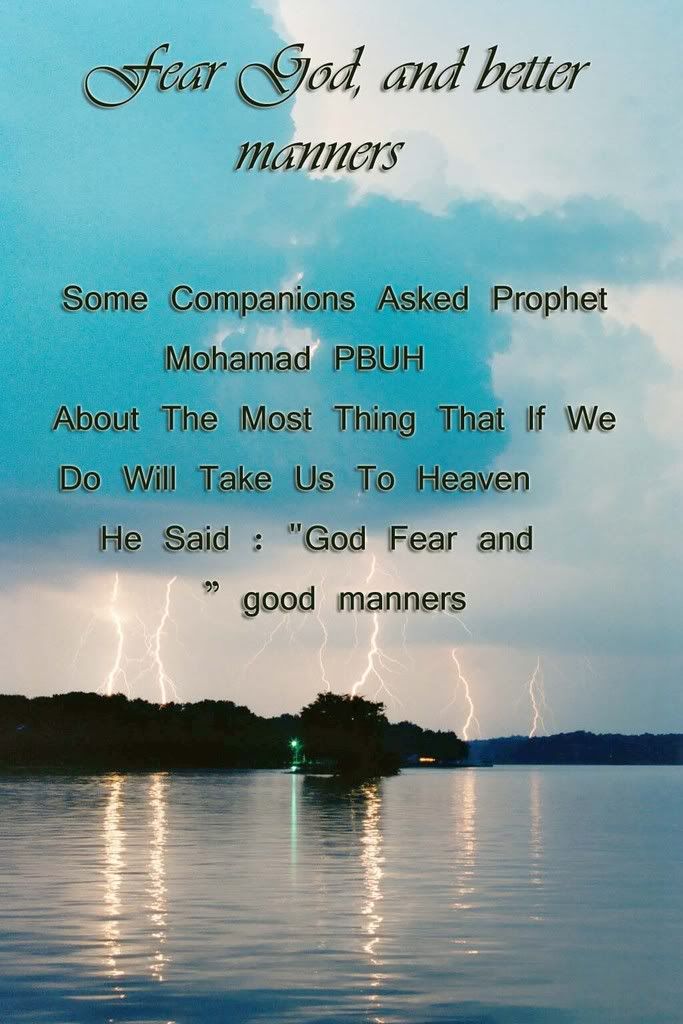
Fear Allah


Islamic Pictures & Wallpapers

Islamic Pictures & Wallpapers

Islamic Pictures & Wallpapers

Islamic Pictures & Wallpapers

Islamic Pictures & Wallpapers

Islamic Pictures & Wallpapers


Words of Wisdom from Prophet Mohammad


Fifty hadiths selected


1.. "Acquire knowledge, it enables its professor to distinguish right from wrong; it lights the way to heaven. It is our friend in the desert, our company in solitude and companion when friendless. It guides us to happiness, it sustains us in misery, it is an ornament amongst friends and an armour against enemies." (widely attributed to the Prophet Mohammed (pbuh))
2.. "A Muslim who plants a tree or sows a field, from which man, birds and animals can eat, is committing an act of charity." (Muslim)
3.. "There is a polish for everything that takes away rust; and the polish for the heart is the remembrance of Allah." (Bukhari)
4.. "What actions are most excellent? To gladden the heart of human beings, to feed the hungry, to help the afflicted, to lighten the sorrow of the sorrowful, and to remove the sufferings of the injured." (Bukhari)
5.. "The most excellent Jihad is that for the conquest of self." (Bukhari)
6.. "If you put your whole trust in Allah, as you ought, He most certainly will satisfy your needs, as He satisfies those of the birds. They come out hungry in the morning, but return full to their nests." (Tirmidhi)
7.. "When Allah created his creatures He wrote above His throne: 'Verily, my Compassion overcomes my wrath." (Bukhari & Muslim)
8.. "Allah will not give mercy to anyone, except those who give mercy to other creatures." (Abdullah b. Amr: Abu Daud & Tirmidhi)
9.. " 'Son, if you are able, keep your heart from morning till night and from night till morning free from malice towards anyone.' Then the Prophet said: 'O my son! This is one of my laws, and he, who loves my laws verily loves me.' " (Bukhari)
10.. "Say what is true, although it may be bitter and displeasing to people." (Baihaqi)
11.. "Kindness is a mark of faith, and whoever is not kind has no faith." (Muslim)
12.. "When you see a person who has been given more than you in money and beauty, look to those, who have been given less." (Muslim)
13.. "If you do not feel ashamed of anything, then you can do whatever you like." (Abu-Masud: Bukhari)
14.. "O Lord, grant me your love, grant me that I love those who love you; grant me, that I might do the deeds that win your love. Make your love dearer to me than the love of myself, my family and wealth." (Tirmidhi)
15.. "It is better to sit alone than in company with the bad; and it is better still to sit with the good than alone. It is better to speak to a seeker of knowledge than to remain silent; but silence is better than idle words." (Bukhari)
16.. "Verily, a man teaching his child manners is better than giving one bushel of grain in alms." (Muslim)
17.. "Whoever is kind, Allah will be kind to him; therefore be kind to man on the earth. He Who is in heaven will show mercy on you."(Abu Daud: Tirmidhi)
18.. "It is difficult for a man laden with riches to climb the steep path, that leads to bliss." (Muslim)
19.. "Once a man, who was passing through a road, found a branch of a tree with torns obstructing it. The man removed the thorns from the way. Allah thanked him and forgave his sins." (Bukhari)
20.. "Who are the learned? Those who practice what they know." (Bukhari)
21.. "Allah has revealed to me, that you must be humble. No one should boast over one another, and no one should oppress another." (Iyad b. Hinar al-Mujashi: Muslim)
22.. "Who is the most favoured of Allah? He, from whom the greatest good comes to His creatures." (Bukhari)
23.. "A true Muslim is thankful to Allah in prosperity, and resigned to His will in adversity." (Muslim)
24.. "A Muslim who meets with others and shares their burdens is better than one who lives a life of seclusion and contemplation. " (Muslim)
25.. "Serve Allah, as you would if you could see Him; although you cannot see Him, He can see you. (Umar: Muslim)
26.. "Allah does not look at your appearance or your possessions; but He looks at your heart and your deeds." (Abu Huraira: Muslim)
27.. "The best richness is the richness of the soul." (at the field ofTabuk, Syria, Rajab 9 A.H.: Bukhari)
28.. "Keep yourselves far from envy; because it eats up and takes away good actions, like a fire eats up and burns wood." (Abu Daud)
29.. "Much silence and a good disposition, there are no two things better than these." (Bukhari)
30.. "Verily, Allah is mild and is fond of mildness, and He gives to the mild what He does not give to the harsh." (Muslim)
31.. "Whoever loves to meet Allah, Allah loves to meet him." (Bukhari)
32.. "Once the Prophet was asked:'Tell us, which action is dearest to Allah?' He answered:'To say your prayer at its proper time.' Again he was asked: 'What comes next?' Mohammed said: 'To show kindness to parents.' 'Then what?' he was asked, 'To strive for the cause of Allah!' " (Ibn Masad: Bukhari)
33.. "When two persons are together, two of them must no whisper to each other, without letting the third hear; because it would hurt him." (Bukhari & Muslim)
34.. "Verily, it is one of the respects to Allah to honor an old man." (Bukhari)
35.. "All Muslims are like a foundation, each strengthening the other; in such a way they do support each other." (Abu Musa: Bukhari & Muslim)
36.. "Strive always to excel in virtue and truth." (Bukhari)
37.. "You will not enter paradise until you have faith; and you will not complete your faith till you love one another." (Muslim)
38.. "He, who wishes to enter paradise at the best gate, must please his father and mother." (Bukhari & Muslim)
39.. "I am leaving two things among you, and if you cling to them firmly you will never go astray; one is the Book of Allah and the other is my way of life." (Farewell Pilgrimage: Muatta)
40.. "Allah is One and likes Unity." (Muslim)
41.. "The best of alms is that, which the right hand gives and the left hand knows not of." (Bukhari)
42.. "The perfect Muslim is not a perfect Muslim, who eats till he is full and leaves his neighbors hungry." (Ibn Abbas: Baihaqi)
43.. "He is not of us who is not affectionate to the little ones, and does not respect the old; and he is not of us, who does not order which is lawful, and prohibits that which is unlawful." (Ibn Abbas: Tirmidhi)
44.. "No man is a true believer unless he desires for his brother that, what he desires for himself." (Abu Hamza Anas: Bukhari & Muslim)
45.. "To strive for the cause of Allah from daybreak to noon and sunset is better than the goods and enjoyment of the whole worldly life." (Bukhari)
46.. "Be not like the hypocrite who, when he talks, tells lies; when he gives a promise, he breaks it; and when he is trusted, he proves dishonest." (Bukhari & Muslim)
47.. "The proof of a Muslim's sincerity is, that he pays no heed to that, which is not his business." (Abu Hureira: Tirmidhi)
48.. "Do you know what is better than charity and fasting and prayer? It is keeping peace and good relations between people, as quarrels and bad feelings destroy mankind." (Muslims & Bukhari)
49.. "Conduct yourself in this world, as if you are here to stay forever; prepare for eternity as if you have to die tomorrow." (Bukhari)
50.. "The worldly comforts are not for me. I am like a traveller, who takes a rest under a tree in the shade and then goes on his way." (Tirmidhi)

Is the Qur'an God's Word?


PEACE - The Solution for Humanity
international Conference and Exhibition - 2007

Is the Qur'an God's Word?
Dr. Zakir Naik


Sharm o Haya

Sharm o Haya

Sharm o Haya

Anas (RA) narrated: Allah's Messenger (saw) said, "Every Deen has a distinctive quality, and the distinctive quality of Islam is Modesty."
Sharm o Haya

Abu Hurairah(RA) narrated: The Prophet (saw) said, "Iman (Faith) has more than sixty branches, and Al Haya (modesty) too is a branch of Iman."
Sharm o Haya

Abu Hurairah (RA) narrated : Allah's Messenger (saw) said , "Modesty is from Iman and Iman leads to paradise and indecency is from the (useless) scum/froth and the (useless) scum/froth leads to the fire"
Sharm o Haya

Salim bin Abdullah narrated from his father that once Allah's Messenger (saw) passed by a man of the Ansaar who was admonishing his brother regarding Haya (modesty). Allah's Messenger (saw) said, "Leave him for modesty is part of Iman."
Sharm o Haya

Abu Sawaar al- Addavi narrated that he heard Imran bin Husayn (RA) who said :The Prophet (saw) said, "Modesty does not bring anything but good."
Sharm o Haya

Imran (RA) narrated one day : The Messenger of Allah (saw) said, "Modesty is all good."
Sharm o Haya

Anas (RA) narrated : Allah's Messenger (saw)said, "There is no indecency in anything except for it makes it defective, and there is no modesty in anything except for it beautifies it."
Sharm o Haya

Abu Saeed Al Khudri (RA) narrated : The Prophet (saw) was more shy than a virgin in her private room, and if he saw a thing which he disliked, we would recognize it on his face."
Sharm o Haya

Abu Masud(RA) narrated: The Prophet (saw) said, "One of the sayings of the early Prophets which was imparted to the people is, "If you do not feel shame, then do as you like."

Kal fursat na mili to kya karo gay???


Kal fursat na mili to kya karo gey,

> > Itni mohlat na mili to kya karo gey,
> >
> > Roz kehte ho kal parhon ga namaz,
> >
> > Kal agar saans na rahi to kya karo ge…
> >
> > Rasam se sunnat achi,
> >
> > Neend se namaz achi,
> >
> > Gunah se neki achi,
> >
> > Bazar se masjid achi
> >
> > Fazool baton se quran ki tilawat achi,
> >
> > Gheebat se zikar acha,
> >
> > Delete se forward acha..
> >
> > Namaz jo hum par farz kar di gayi hai....
> >
> > Fajar....bister main
> >
> > Zohar..naukri main
> >
> > Asar.....chaye main
> >
> > Maghrib...rastey main
> >
> > Esha......tv main
> >
> > Jumma.... sonay main
> >
> > Eid.....bazaaron main
> >
> > Na Durood, Na Quran.... Yeh Kaisa Hai (Musalman) ?

Phir kahtay ho q nahin hai Allah hum par meharban to Namaz parhao is say pahlay k tumhari Namaz parhi jayee.....

Is msg ko itna phela do jitna Allah or us kay Nabi say pyar hai kartay ho

Allah hum sab ko namaz parhnay ki toufeeq ata farmaey. Aameen